How to Choose the Right Brake Line for Motorcycle Upgrades: Materials, Fittings and Applications
Choosing the right brake line is an important step in motorcycle brake system upgrades. Material selection, pressure resistance, fitting compatibility, hose length, and installation requirements all influence the suitability of a brake line assembly. For motorcycle owners, repair workshops, aftermarket brands, and wholesale distributors, understanding these factors helps ensure that the selected product matches the intended application.
Motorcycle brake lines are available in different constructions, including rubber brake hose assemblies, PTFE brake lines, Teflon brake lines, nylon brake line products, and stainless steel braided brake lines. Although these products may serve different applications, they should never be considered interchangeable without checking their specifications and intended use.
This guide explains how to compare motorcycle brake line materials, select compatible fittings, evaluate reinforced hose construction, and source customized brake line assemblies for different vehicle applications and international markets.
1. What Is a Motorcycle Brake Line?
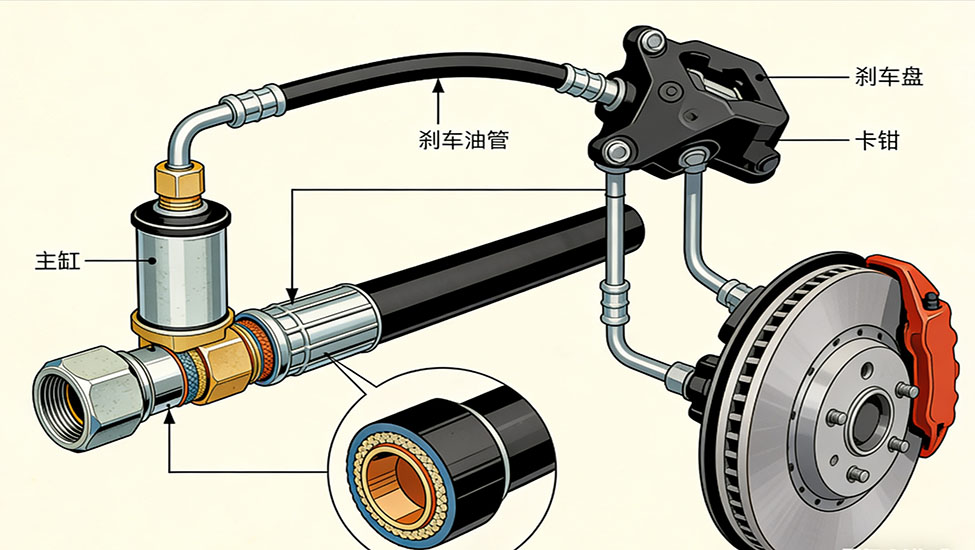
A motorcycle brake line is part of the hydraulic braking system. It transfers brake fluid pressure between hydraulic components, allowing the braking force applied at the master cylinder to operate the brake caliper.
1.1 Main Components of a Brake Line Assembly
- Inner tube: Carries the brake fluid and must be compatible with the specified fluid and operating conditions.
- Reinforcement layer: Helps the assembly withstand hydraulic pressure and control expansion, depending on its construction.
- Outer protective layer: May provide abrasion resistance, environmental protection, or a decorative finish.
- End fittings: Connect the hose to the master cylinder, caliper, or other specified hydraulic components.
- Crimped or assembled connections: Secure the hose and fittings according to the manufacturer's validated production specifications.
1.2 Why Correct Brake Line Selection Matters
A brake line must meet the vehicle's pressure, temperature, fluid compatibility, and installation requirements. Incorrect hose dimensions, unsuitable fittings, or an incompatible inner tube can compromise braking system reliability.
For aftermarket upgrades, the goal should be to select a properly engineered assembly that meets the vehicle's requirements rather than choosing a product based only on appearance or material name.
2. Compare Different Motorcycle Brake Line Materials
Different brake line constructions offer different combinations of flexibility, chemical resistance, reinforcement, and mechanical protection. Buyers should compare the complete assembly specifications before placing an order.
2.1 Teflon Brake Line
Teflon is a commonly used trade name for PTFE, or polytetrafluoroethylene. Teflon brake lines generally refer to brake line assemblies that use a PTFE inner tube, although the precise construction depends on the product.
Key Selection Factors
- Verify the inner tube material and brake fluid compatibility.
- Check the rated working pressure and operating temperature.
- Confirm the reinforcement structure and fitting design.
- Ensure that the complete assembly is designed for the intended braking system.
Teflon brake lines are often considered for specialized and performance-oriented applications because PTFE offers broad chemical resistance and useful thermal properties. However, the performance of the finished product depends on the complete hose construction and manufacturing quality.
2.2 PTFE Brake Line Assembly
A PTFE brake line assembly combines a PTFE inner tube with suitable reinforcement and end fittings. Depending on the design, reinforcement may include stainless steel wire braiding or other engineered structures.
Important Assembly Specifications
- Required hose length and internal dimensions.
- Inner tube and reinforcement materials.
- Fitting type, thread specification, and connection angle.
- Working pressure and operating temperature limits.
- Brake fluid compatibility and applicable product standards.
For motorcycle aftermarket projects, buyers should confirm all assembly details before production. A PTFE inner tube alone does not establish that a brake line is suitable for a specific vehicle.
2.3 Nylon Brake Line
Nylon tubing is used in various automotive, motorcycle, and industrial fluid or air systems. Its suitability depends on the nylon grade, tubing construction, pressure requirements, temperature range, and intended medium.
Importantly, not every nylon tube is suitable for hydraulic braking. A nylon brake line should only be used when the complete product has been specifically designed, validated, and approved for the intended brake system. General-purpose nylon tubing must not be substituted for a qualified hydraulic brake hose.
What Buyers Should Confirm
- The exact nylon material grade and intended application.
- Pressure and temperature performance under specified conditions.
- Compatibility with the required fluid.
- Whether the product is approved for hydraulic brake service.
2.4 Nylon Brake Line Assembly
A nylon brake line assembly may be suitable for particular applications where its material and construction meet the required technical specifications. However, its suitability for a hydraulic braking system must be verified rather than assumed from its product name.
For OEM purchasing and aftermarket sourcing, technical documentation should identify the intended medium, operating limits, connection requirements, and applicable standards. If the product is intended for a non-braking application, it should not be marketed or installed as a motorcycle hydraulic brake line.
2.5 Rubber Brake Line Assembly
Rubber brake hose assemblies are widely used in original equipment and replacement braking systems. Their flexibility makes them suitable for many standard motorcycle and scooter applications.
Advantages and Considerations
- Flexible routing for many vehicle configurations.
- Different rubber compounds and reinforcement designs for different specifications.
- Availability in a range of dimensions and fitting configurations.
- Service life influenced by heat, ozone, abrasion, chemicals, and maintenance conditions.
When sourcing a rubber brake line assembly, buyers should confirm the approved pressure range, operating temperature, brake fluid compatibility, fitting dimensions, and vehicle application.
2.6 Stainless Steel Braided Hose
A stainless steel braided hose uses stainless steel wire reinforcement around an inner tube. In many performance motorcycle brake line designs, the inner tube is made from PTFE and the outer stainless steel braid helps control expansion under hydraulic pressure.
Benefits of Stainless Steel Reinforcement
- Helps limit hose expansion when properly designed for the required pressure.
- Can support a more consistent brake lever feel as part of a correctly specified system.
- Provides a reinforced construction for suitable motorcycle applications.
- Can be combined with compatible protective covers and different fitting configurations.
Stainless steel braiding does not automatically make a hose suitable for every brake system. The inner tube, fittings, reinforcement design, assembly quality, and product ratings must all be considered.
2.7 Braided Brake Lines
Braided brake lines are commonly selected for motorcycle aftermarket upgrades where controlled hose expansion, a reinforced construction, and customized connection configurations are important. Product designs may vary in inner tube material, braid structure, protective covering, and end fittings.
For distributors and motorcycle accessory brands, selecting the correct braided brake lines requires checking technical specifications and confirming fitment for each intended motorcycle model.
3. How to Select the Correct Brake Line Length and Fittings
Even a well-manufactured brake hose can be unsuitable if its length or fittings do not match the vehicle. Fitment verification is therefore essential when replacing an original hose or developing a customized brake line assembly.
3.1 Measure the Required Hose Length
Measure the required routing according to the vehicle manufacturer's procedure or an approved reference assembly. The measurement should account for steering movement, suspension travel, connection positions, and the specified routing path.
A hose that is too short may become stretched during operation, while an excessively long hose may rub against other components or interfere with vehicle movement.
3.2 Confirm Fitting Types and Angles
Brake hose assemblies may use different connection styles and fitting angles. Buyers should verify thread specifications, sealing arrangements, fitting orientation, and connection compatibility before ordering.
3.3 Check Installation Clearance
The installed hose must remain clear of sharp edges, moving parts, and excessive heat sources. It must not become kinked, twisted, pinched, or stretched during normal steering and suspension movement.
3.4 Verify Hydraulic Specifications
Confirm that the complete assembly meets the required working pressure, temperature limits, brake fluid compatibility, and applicable standards. Do not assume that a hose with matching dimensions will automatically meet the vehicle's technical requirements.
4. How to Choose Brake Lines for Different Motorcycle Applications
4.1 Standard Motorcycles
For standard road motorcycles, the selected brake line should meet the original equipment requirements or the applicable approved replacement specification. Correct fitment, fluid compatibility, and reliable connections are essential.
4.2 Modified and Performance Motorcycles
Modified motorcycles may require specific hose lengths, fitting angles, reinforcement structures, or protective covers. Reinforced brake line assemblies can be considered when they have been designed and validated for the intended application.
4.3 Scooters
Scooters often operate in dense urban traffic and may experience frequent braking, humidity, rain, and repeated heat cycles. Buyers should select assemblies that meet the scooter's hydraulic specifications and installation requirements.
4.4 ATVs and Off-Road Vehicles
ATVs and off-road motorcycles may encounter dust, mud, vibration, water, and mechanical abrasion. Hose routing, protective covering, fitting retention, and resistance to the expected environment should be considered alongside pressure and temperature ratings.
5. Common Mistakes When Buying Aftermarket Brake Lines
5.1 Choosing Products by Appearance Only
A braided outer layer or attractive finish does not establish pressure capability, fluid compatibility, or temperature resistance. Technical documentation should be checked before purchase.
5.2 Assuming All PTFE and Nylon Products Are Interchangeable
Different polymers have different properties, and product suitability depends on the exact formulation and construction. General-purpose tubing should never be used in a hydraulic braking system unless it has been specifically qualified for that purpose.
5.3 Ignoring Fitting Compatibility
Incorrect thread dimensions, fitting angles, or sealing arrangements can cause installation difficulties and potentially dangerous leakage. Confirm the required specifications before manufacturing or ordering a replacement assembly.
5.4 Overlooking Quality Control
Consistent crimping, material traceability, dimensional inspection, and appropriate performance testing are important when evaluating brake hose manufacturers. Buyers should request relevant technical documents and quality records where available.
6. What B2B Buyers Should Look for in a Brake Line Manufacturer
For importers, wholesalers, motorcycle parts distributors, and aftermarket brands, supplier evaluation should cover technical capability, customization, manufacturing consistency, and export requirements.
6.1 Custom Manufacturing Capabilities
- Custom hose lengths and approved fitting configurations.
- Different inner tube and reinforcement constructions for suitable applications.
- Protective sleeves and appearance options where available.
- Sample development based on drawings, reference parts, or confirmed specifications.
6.2 Quality and Product Documentation
- Documented pressure and temperature ratings.
- Material and brake fluid compatibility information.
- Applicable test reports and product compliance documentation.
- Dimensional inspection and assembly quality control procedures.
- Batch identification and traceability, where provided.
6.3 Export and Wholesale Requirements
International buyers should also confirm minimum order quantities, sample lead times, production schedules, packaging requirements, shipping arrangements, and the supplier's ability to maintain consistent specifications across repeat orders.
For markets across Southeast Asia, the Middle East, Japan, South Korea, and Africa, vehicle fitment data and applicable local requirements should be verified for each product range.
7. Frequently Asked Questions About Motorcycle Brake Lines
What is the difference between a Teflon brake line and a PTFE brake line?
Teflon is a commonly used trade name for PTFE. In brake line terminology, both terms often refer to products with a PTFE inner tube. Buyers should confirm the actual material and complete assembly construction with the manufacturer.
Are stainless steel braided brake lines better than rubber brake hoses?
They have different construction characteristics. Properly designed braided brake lines can help control hose expansion under pressure, while rubber brake hoses provide flexibility for many standard applications. The appropriate choice depends on vehicle specifications, product ratings, intended use, and applicable regulations.
Can nylon tubing be used as a motorcycle brake line?
Only a product specifically designed, validated, and approved for the intended hydraulic braking application should be considered. General-purpose nylon tubing is not automatically suitable for brake fluid service or hydraulic brake pressure.
What information is required for a custom brake line order?
Useful information includes the motorcycle model, hose length, fitting types, thread specifications, fitting angles, required material, reinforcement structure, brake fluid specification, working pressure, temperature range, and applicable product standards.
What should importers check before choosing a brake hose supplier?
Importers should review technical specifications, product compatibility, quality control procedures, sample availability, customization capabilities, production consistency, packaging, and export experience.
Conclusion: Choose Brake Lines Based on Specifications and Application
Selecting the right motorcycle brake line requires more than comparing material names or external appearance. Inner tube construction, reinforcement, fitting compatibility, working pressure, temperature capability, and installation routing all influence whether an assembly is suitable for its intended application.
Teflon brake lines, PTFE brake line assemblies, rubber brake line assemblies, and stainless steel braided brake lines serve different design requirements. Nylon brake line products must also be evaluated carefully to confirm that the exact product is suitable for its intended medium and operating conditions.
For motorcycle manufacturers, aftermarket distributors, and wholesale buyers, working with a qualified brake hose manufacturer and providing clear technical specifications can help improve fitment accuracy, maintain product consistency, and support reliable sourcing for different international markets.