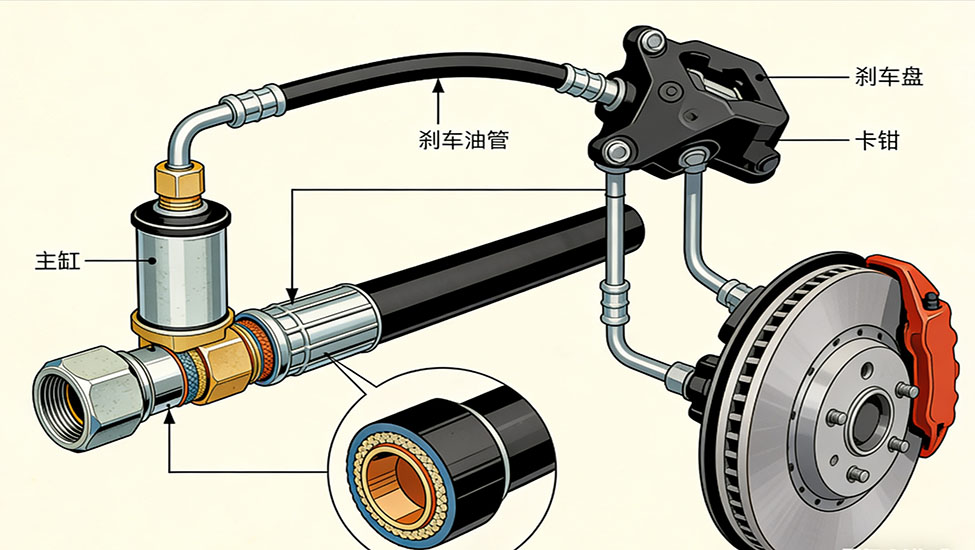
Motorcycle Brake Hose Selection Guide: Match the Brake Line to Your Riding Needs
When replacing or upgrading motorcycle brake hoses, many buyers start with the motorcycle model. This is useful, but it is not enough for every application.
A standard motorcycle, a touring bike and a heavily modified motorcycle can require completely different brake hose specifications even when some of the original components are similar.
Start With the Motorcycle Brake System
Before choosing a hose, identify the basic brake system configuration. Check whether the hose is used for the front brake, rear brake or a multi-line system.
Information Worth Recording
- Motorcycle make and model
- Model year
- Front or rear brake
- Master cylinder type
- Caliper type
- Existing hose length
- Fitting type
- Fitting angle
Standard Motorcycle vs Modified Motorcycle
Standard Motorcycle
For an original motorcycle, replacing the brake hose with a product matching the original dimensions and connection specifications is normally the simplest approach.
Flexibility, durability and correct fitment are usually more important than adding unnecessary modifications.
Modified Motorcycle
Once the handlebar, caliper, master cylinder, fork or other brake components are changed, the original hose specification may no longer be suitable.
This is where customized motorcycle brake lines become useful.
When Is a Teflon Brake Line Worth Considering?
Teflon, or PTFE, is widely used in hydraulic applications because of its chemical resistance and stable performance over a broad temperature range.
A Teflon Brake Line can be considered for motorcycle modification projects where a PTFE inner tube construction is required.
What Buyers Should Understand
PTFE is not a magic material that automatically improves every brake system. The complete construction, reinforcement, fittings and installation quality still determine whether the finished brake line is suitable.
When Is Nylon Brake Hose a Practical Option?
Nylon brake hose can offer low weight and flexibility, which can be useful for certain motorcycle applications.
A Nylon Brake Line should still be selected according to pressure, temperature, brake fluid compatibility and the requirements of the complete hydraulic system.
What About Rubber Brake Hose?
Rubber remains a common brake hose material because it is flexible and suitable for many original-equipment applications.
For customers looking for a complete replacement assembly, a Rubber Brake Line Assembly can be specified according to the original application.
Why Do Riders Upgrade to Braided Brake Lines?
One of the most common reasons for upgrading motorcycle brake hoses is the desire for a more consistent brake lever response.
In a reinforced hose, the outer braid helps control expansion of the hose under hydraulic pressure. Depending on the original hose and overall brake system, this may make the lever feel more direct.
What a Braided Brake Line Cannot Do
A brake line cannot compensate for worn brake pads, contaminated brake fluid, a damaged caliper, poor tires or an incorrectly adjusted brake system.
A hose upgrade should therefore be treated as one part of a complete brake system improvement.
How Overseas Riders Usually Evaluate Brake Lines
For riders and workshops in Southeast Asia, the Middle East, Japan, Korea and Africa, environmental conditions can be very different.
High Temperature
Hot climates can place greater demands on brake system components. Hose material and construction should therefore be selected according to the actual operating conditions.
Humidity and Rain
Frequent exposure to water and humidity makes corrosion resistance and proper maintenance important.
Dust and Road Debris
Brake hose routing should keep the line away from unnecessary abrasion and contact with sharp components.
Heavy Traffic
Frequent braking in urban traffic can increase brake system temperature and makes regular inspection more important.
Do You Need a Custom Brake Hose Assembly?
If the motorcycle has non-standard brake components, a complete assembly is often easier to specify than buying hose and fittings separately.
Our PTFE Brake Line Assembly can be configured with different lengths and fitting requirements for customized projects.
How to Avoid Ordering the Wrong Brake Hose
Do Not Rely Only on the Motorcycle Model
The model name may not describe aftermarket changes already made to the motorcycle.
Do Not Guess the Length
Measure the actual routing or provide the original hose as a reference.
Do Not Guess the Thread
Confirm thread diameter, pitch and connection type before production.
Do Not Ignore Fitting Orientation
The fitting angle can determine whether the finished hose follows the correct route without twisting or excessive bending.
How to Maintain a Motorcycle Brake Hose
- Inspect the outer surface periodically.
- Check for abrasion and cracks.
- Inspect fitting areas for leakage.
- Check the hose after major motorcycle modifications.
- Keep the line away from exhaust heat and sharp edges.
- Confirm the hose has sufficient movement during steering.
Our Brake Hose Manufacturing Service
We manufacture brake hoses and brake line assemblies for motorcycle aftermarket, replacement and modification applications.
Our product range includes Teflon brake lines, nylon brake lines, PTFE brake line assemblies, nylon brake line assemblies and rubber brake line assemblies.
For distributors and workshops, we can also work from drawings, samples and customer specifications to support repeat production.
Have an Existing Hose?
If you have an original brake hose but are unsure about its dimensions or fitting specifications, send us clear photographs or a sample. This is often more reliable than trying to identify every dimension from memory.
Contact Us for Motorcycle Brake Line Customization
FAQ
How often should a motorcycle brake hose be replaced?
Replacement depends on the hose material, age, environment and physical condition. Inspect the hose regularly and replace it when deterioration, leakage or damage is found.
Does upgrading the brake hose improve safety?
A correctly specified brake hose can contribute to reliable and consistent hydraulic operation, but overall braking safety also depends on the caliper, pads, discs, brake fluid, tires and correct installation.
Can one brake hose fit several motorcycle models?
Some applications may share similar specifications, but compatibility should always be confirmed by checking hose length, fittings, thread specifications and routing.
Should I choose PTFE or nylon?
Both materials have different characteristics. The correct choice depends on pressure, temperature, brake fluid compatibility, flexibility and the intended application.