Recent News
-
 2025-12-26
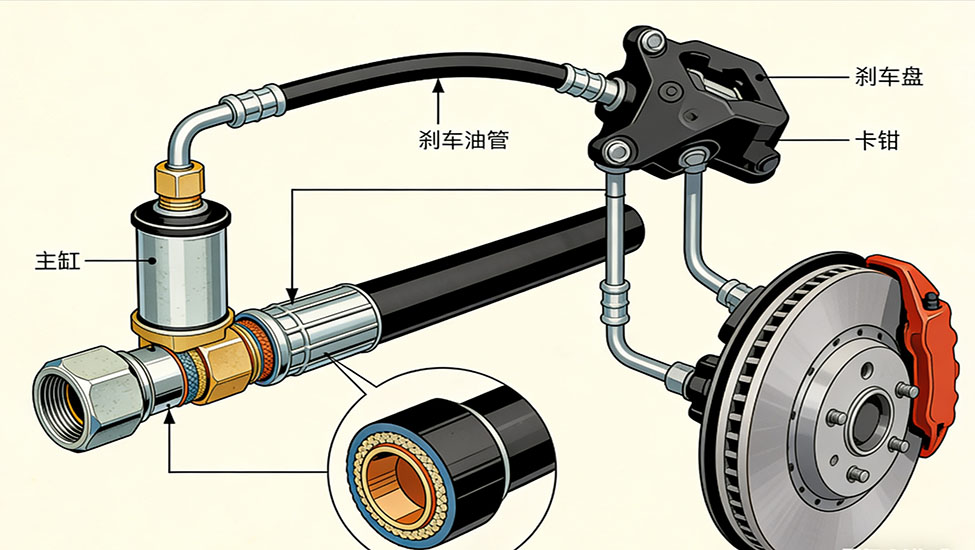
Working principle of brake lines

When upgrading a vehicle's braking system, many customers ask one important question: Are stainless steel braided brake lines better than traditional rubber brake hoses?
Both types of brake hoses are widely used in automotive and motorcycle applications. However, they have different structures, performance characteristics, and suitable applications.
Understanding the differences between braided brake lines and rubber brake hoses helps vehicle owners, modification shops, and international buyers choose the correct brake hose solution.
The brake hose is responsible for transferring hydraulic pressure from the master cylinder to the brake caliper.
During braking, the hose must withstand:
A suitable brake hose improves braking consistency, while an unsuitable or aged hose may affect brake response and driving safety.
Stainless steel braided brake lines use a flexible inner tube combined with a stainless steel braided reinforcement layer.
The braided stainless steel structure helps control hose expansion under pressure, allowing hydraulic force to transfer more efficiently.
Rubber brake hoses are commonly installed on many original vehicles because rubber provides good flexibility, vibration absorption, and cost efficiency.
For normal daily driving conditions, high-quality rubber brake hoses can provide reliable braking performance.
| Feature | Stainless Steel Braided Brake Lines | Rubber Brake Hoses |
|---|---|---|
| Pressure Stability | Excellent | Standard |
| Expansion Under Pressure | Very Low | Higher |
| Temperature Resistance | Excellent | Medium |
| Performance Driving | Excellent | Limited |
| Flexibility | Good | Excellent |
| Cost | Higher | Lower |
The biggest advantage of braided brake lines is improved pressure stability.
When braking force increases, rubber hoses may expand slightly. This expansion can reduce the feeling of direct braking response.
Stainless steel braided brake lines reduce this expansion and provide a firmer brake pedal or lever feeling.
High-performance vehicles often experience repeated hard braking, which creates heat and pressure changes.
Braided brake lines maintain more stable performance during:
The stainless steel reinforcement layer provides additional protection against abrasion, vibration, and environmental conditions.
Modern performance brake systems often combine stainless steel braided structures with PTFE inner tubes.
Teflon Brake Lineprovides excellent chemical resistance and stable performance under high temperature conditions.
PTFE Brake Line Assemblyis designed for customers requiring complete customized brake hose solutions.
It is widely used in:
Nylon Brake Lineis suitable for applications requiring lightweight construction and flexible installation.
Nylon Brake Line Assemblyoffers customized length and fitting options for different vehicle requirements.
Rubber Brake Line Assemblyis commonly selected for standard replacement vehicles where flexibility and cost efficiency are important.
Customers should confirm the inner tube material, reinforcement structure, fitting quality, and production process before purchasing.
Different vehicles require different specifications.
Professional manufacturers should support:
Reliable brake hose suppliers should perform pressure testing and leakage inspections before delivery.
We manufacture stainless steel braided brake lines, PTFE brake lines, nylon brake hoses, and rubber brake assemblies for customers worldwide.
Our engineering team supports customized solutions based on drawings, samples, vehicle models, and installation requirements.
Contact our engineering team for custom brake hose solutions.
High-quality braided brake lines provide better pressure stability and more consistent braking performance, especially in demanding applications.
They mainly improve brake response and consistency by reducing hose expansion, while braking power also depends on calipers, pads, and discs.
Service life depends on materials, installation quality, environment, and maintenance conditions.
Yes. Professional manufacturers can customize length, fittings, colors, and specifications according to customer requirements.
