Stainless Steel Braided Brake Lines vs Rubber Brake Hoses: Why Does Brake Feel Change?
One of the most common questions from motorcycle riders after upgrading their brake system is why a stainless steel braided brake line can feel different from the original rubber brake hose.
The difference is mainly related to hose construction and how the hose behaves when hydraulic pressure increases. Understanding this helps riders, workshops and motorcycle parts buyers choose the correct brake hose instead of choosing only by appearance or price.
How Hydraulic Brake Pressure Reaches the Caliper
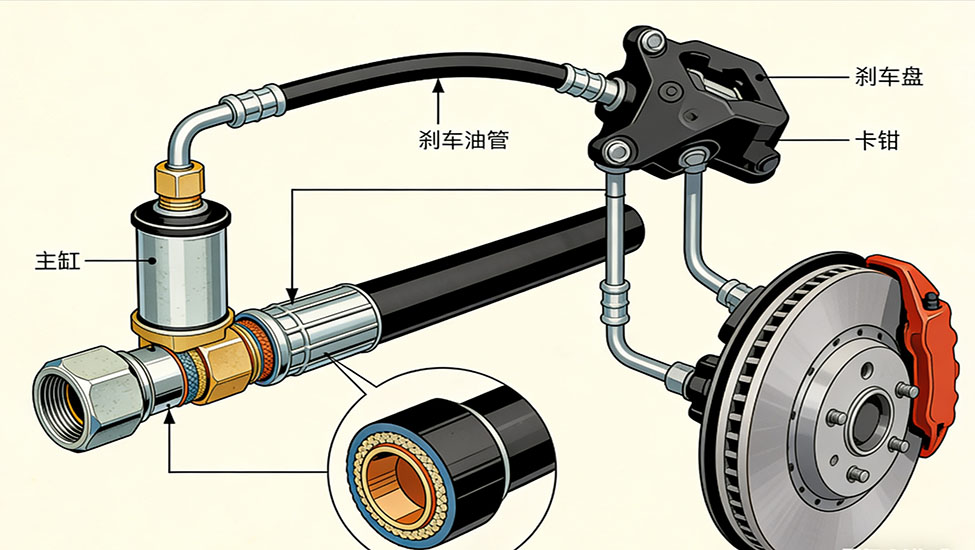
When the rider pulls the brake lever, the master cylinder generates hydraulic pressure. Brake fluid transfers this pressure through the brake hose to the caliper, where the brake pads clamp the disc.
The Brake Hose Is Part of the Hydraulic System
The hose is not simply a flexible connection between two components. Its ability to withstand pressure and maintain its dimensions affects how the rider feels the brake lever.
Why Does a Rubber Hose Feel Softer?
Rubber is naturally flexible. Under hydraulic pressure, a flexible hose can expand to some degree.
On a standard motorcycle used for normal street riding, this is generally acceptable. However, during repeated hard braking, some riders may notice that the lever feels less firm than they expect.
Age Can Also Affect Hose Condition
Brake hoses are exposed to heat, vibration, moisture, UV radiation and environmental conditions. Over time, hose materials can deteriorate.
A hose that shows cracking, swelling, leakage or serious surface damage should be inspected and replaced regardless of whether the motorcycle is used for performance riding.
Why Does Stainless Steel Braiding Change Brake Feel?
Reinforcement Controls Expansion
The stainless steel braid surrounding the inner hose provides mechanical reinforcement. Its main function is to limit dimensional expansion when hydraulic pressure rises.
The Result Is a More Direct Lever Response
With less hose expansion, more of the lever movement can be translated into hydraulic system movement. Riders commonly describe the result as a firmer, more direct or more consistent brake lever.
Firm Feel vs More Braking Power
A firmer brake lever should not be confused with automatically greater braking power. The hose affects hydraulic response, while stopping performance depends on the entire braking system.
Stainless Steel Braided Brake Lines vs Rubber Brake Lines
| Factor | Stainless Steel Braided | Rubber |
|---|---|---|
| Hose reinforcement | Stainless steel braid | Flexible hose construction |
| Expansion control | Generally better | More flexible |
| Brake lever feel | Often firmer and more consistent | Generally softer |
| Customization | High | Usually more standardized |
| Aftermarket use | Very common | Common for standard replacement |
Why PTFE Is Often Used in Braided Brake Lines
Many performance brake hose assemblies use PTFE as the inner tube and stainless steel wire as the reinforcement layer.
PTFE Inner Tube
PTFE has good chemical resistance and is widely used in fluid-handling applications. In brake hose construction, it provides the inner passage for brake fluid.
Our Teflon Brake Line and PTFE Brake Line Assembly products are designed for applications where a PTFE-based brake hose construction is required.
Stainless Steel Reinforcement
The stainless steel braid surrounds the inner tube and helps control expansion under pressure.
Is Nylon Brake Line a Different Solution?
Yes. Nylon brake hose constructions have different characteristics and can be suitable for applications where a nylon tube is preferred.
For customers developing different product series, our Nylon Brake Line and Nylon Brake Line Assembly products provide alternative brake hose configurations.
When Is a Rubber Brake Line Still a Good Choice?
Stainless steel braided brake lines are not automatically necessary for every motorcycle.
For many standard street motorcycles, a properly maintained rubber hose remains a practical solution.
Our Rubber Brake Line Assembly is suitable for applications where a conventional flexible brake hose construction is required.
Who Can Benefit Most From Braided Brake Lines?
Sport Riders
Riders who regularly brake hard may appreciate the more consistent lever response of a reinforced brake hose.
Motorcycle Modification Shops
Custom motorcycles often require non-standard hose lengths and fitting configurations. Braided brake lines provide more flexibility for custom assemblies.
Motorcycle Parts Distributors
Distributors can offer different hose colors, lengths and fitting combinations for aftermarket customers.
Performance Motorcycle Builders
For custom builds, the brake hose can be specified according to both technical requirements and the visual design of the motorcycle.
What Do Overseas Buyers Usually Check?
Fitment
The hose must match the motorcycle's connection points and routing.
Material
Buyers should understand whether the product uses rubber, nylon, PTFE or another inner hose construction.
Fitting Quality
Thread specifications, banjo angles and crimping quality should be confirmed before bulk production.
Consistency
For wholesale orders, consistent hose length, fitting dimensions and assembly quality are important for reducing installation problems and returns.
Brake Hose Maintenance Tips
Inspect the Hose Regularly
Check the hose for cuts, abrasion, swelling, deformation and other visible damage.
Check for Brake Fluid Leakage
Leakage around the hose or fittings requires immediate inspection.
Check the Routing
Make sure the hose does not rub against moving components or become stretched when the handlebar or suspension moves.
Our Main Brake Hose Range
Our main products cover different brake hose constructions for motorcycle and vehicle applications, including Teflon Brake Line, Nylon Brake Line, PTFE Brake Line Assembly, Nylon Brake Line Assembly and Rubber Brake Line Assembly.
We also supply stainless steel braided brake line solutions for aftermarket, motorcycle modification and customized applications.
FAQ About Motorcycle Brake Feel
Why does my brake lever feel soft?
A soft lever can have several causes, including air in the hydraulic system, old brake fluid, hose condition, master cylinder problems or caliper issues. The complete brake system should be inspected rather than assuming that the hose is the only cause.
Will a braided brake line make my motorcycle brake better?
It can improve brake lever consistency by controlling hose expansion, but it does not independently increase the friction generated by the brake pads and disc.
How often should motorcycle brake hoses be replaced?
Replacement depends on hose age, condition, material and operating environment. Follow the motorcycle manufacturer's recommendations and replace the hose when deterioration, leakage or damage is found.
Is a braided brake line suitable for all motorcycle models?
No universal hose fits every motorcycle. Length, fittings, thread size, banjo angle and ABS configuration must be confirmed.
Can you produce customized brake lines?
Yes. Send us a drawing, sample or clear photographs showing the dimensions and fittings. We can review the requirements and discuss a suitable configuration.
Contact us for custom brake hose development and wholesale inquiries.
Conclusion
The difference in brake feel between rubber and stainless steel braided brake lines mainly comes from the way the hose behaves under hydraulic pressure.
A reinforced braided construction can reduce hose expansion and provide a firmer, more consistent lever response. For riders and aftermarket buyers, the important point is to select the complete brake hose assembly according to the motorcycle rather than focusing only on the hose material.